
Safety when working with asbestos
In 2023 the EU cut the permitted concentration of asbestos in the workplace tenfold.[1] Latvia transposed the requirements through amendments to Cabinet Regulation No. 852 that entered into force on 21 December 2025.[2] Asbestos removal now requires a permit from the State Labour Inspectorate (VDI).[3]
Permitted concentration in the air
| Period | Occupational exposure limit (8-hour time-weighted average) |
|---|---|
| Until 20 Dec 2025 | |
| From 21 Dec 2025 | 0.01 fibres/cm³[4][2] |
| From 21 Dec 2029 | 0.002 fibres/cm³, or 0.01 fibres/cm³ if thin fibres (width <0.2 µm), visible only by electron microscopy, are also counted[4][2] |
Until 20 December 2029 fibres may be counted using the existing method; from 21 December 2029 at the latest, measurements must be made by electron microscopy or another equally accurate method.[2][4]
The exposure limit is not a “safe level”, because asbestos is carcinogenic at any dose.[5] Exposure must be kept as low as technically possible.[4] The concentration must be measured initially at every workplace where exposure is possible, as well as during specific tasks and at regular intervals.[3]
If the limit is exceeded, work must stop until protective measures are in place; workers and their trusted representatives must be informed immediately, the causes identified, and the effectiveness of the measures checked by new measurements.[2]
It is prohibited to spray asbestos or to use low-density (less than 1 g/cm³) asbestos-containing thermal or acoustic insulation materials. The extraction of asbestos and the manufacture and processing of asbestos products are also prohibited.[3]
VDI notification and permit
- Notify the VDI 10 working days before work with asbestos begins. The notification states the employer, the site, the timing and duration of the work, the type and quantity of asbestos, the working methods and waste management, a list of the workers with details of their training and last health check, and the protective measures and equipment.[3]
- Removal requires a VDI permit. If the VDI has not refused within 10 working days, the permit is deemed to have been issued. The VDI publishes a list of employers holding a permit on its website.[3]
- Urgent work. If removal must be carried out immediately because of force majeure or other exceptional circumstances, the notification must be submitted to the VDI no later than the moment work begins.[2]
Tip for homeowners: if you hire a firm to replace your roof, make sure it appears on the list of permit holders published by the VDI (vdi.gov.lv).[3]
When no notification is needed: if exposure is sporadic and of low intensity, the risk assessment shows that the exposure limit will not be exceeded, and the work is one of the following: short, intermittent maintenance involving only non-friable materials; removal of intact materials without damaging them; encapsulation or sealing of materials in good condition; air monitoring and sampling. All three conditions must be met.[3]
Removal plan
Before removing asbestos-containing components, the employer draws up a removal plan and submits it to the VDI on request. The plan also covers the dismantling of equipment and ships.[3] It provides for:
- asbestos-containing materials to be removed before the building or equipment is demolished, unless leaving them in place would be safer;
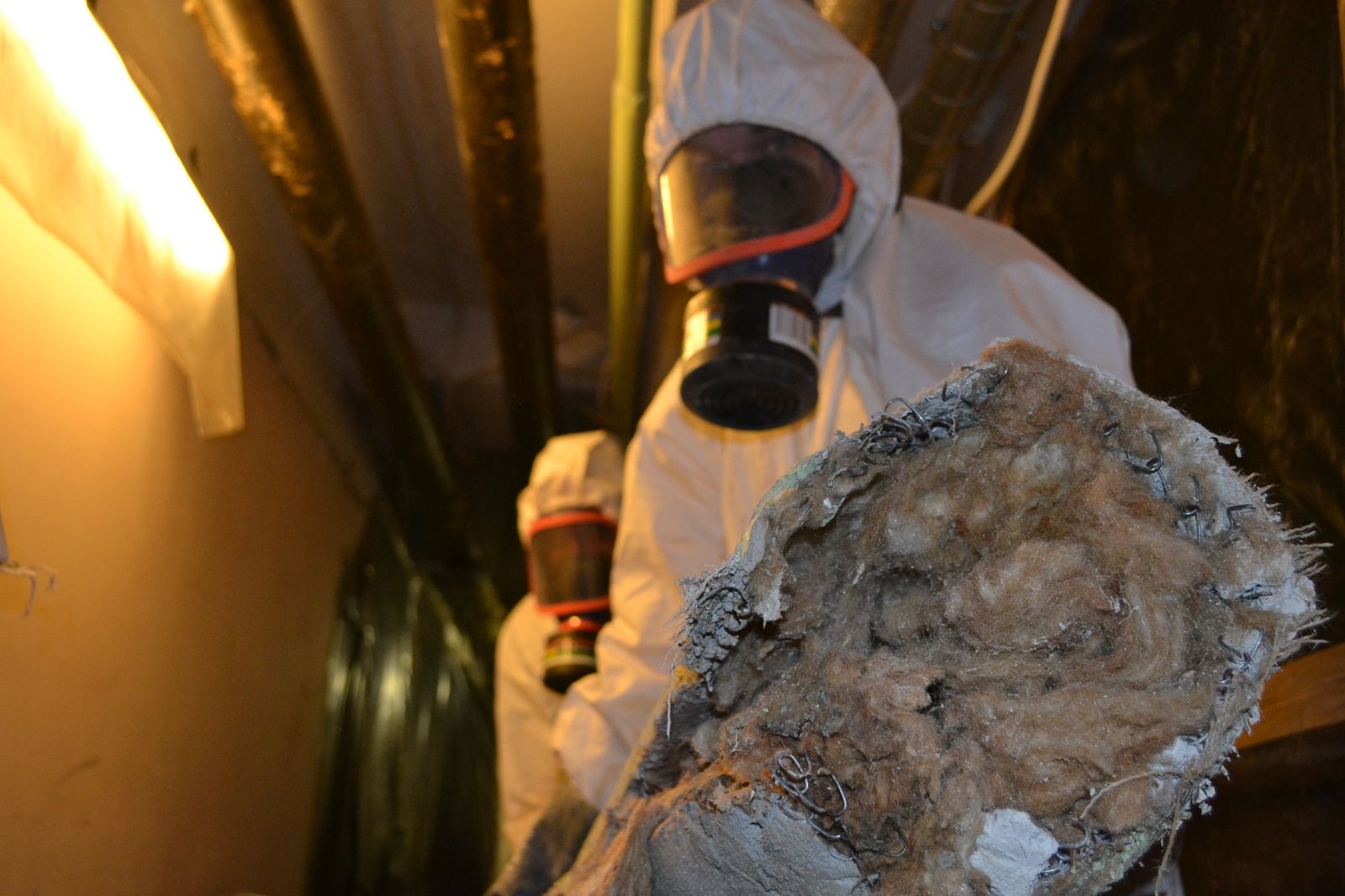
- workers to be provided with personal protective equipment;
- air measurements after removal, before any other work starts in the area;
- at the VDI’s request, also: a description and the duration of the work, the site, the responsible specialist, the methods, a list of protective equipment and measures to protect the environment, local residents and other workers.[3]
Employer’s duties
- Before work, find out whether asbestos is present. Before demolition, repair, maintenance or renovation of buildings constructed before the asbestos ban, the employer identifies any materials that may contain asbestos, for example from information provided by the owner or from construction documents.[2]
- Assess the risk, involving employees’ trusted representatives and the workers themselves.[3]
- Replace asbestos with materials that pose no risk, wherever possible.[3]
- Measure the concentration in the air of the work area; measurements are carried out by an accredited laboratory.[2]
- Pack and remove the waste in sealed packaging labelled “asbestos”, immediately or at the latest at the end of each stage of work.[3]
- Provide mandatory health checks once a year.[6] Specialists recommend continuing surveillance after exposure has ended.[7]
- Keep records and examination results for 40 years after exposure has ended.[3][1]
Compliance with the regulations is monitored by the State Labour Inspectorate.[3]
Training
Training takes place before work begins and is repeated whenever necessary. It must cover both theory and practical skills.[3] At a minimum, it must include:[3]
- the properties of asbestos and its effects on health, including its heightened effect on smokers;
- materials that may contain asbestos, and activities that lead to exposure;
- safe working methods, collective and personal protective equipment, especially respiratory protection;
- emergency procedures, decontamination, waste management and health surveillance;
- equipment for limiting the release of fibres during removal work.
Document checklist
The RSU Institute of Occupational Safety and Environmental Health recommends keeping the following documents on site:[8]
- An inventory of asbestos-containing materials, or an equivalent document
- Air measurement results: before the work and after removal
- Removal plan
- Notification to the VDI (and, for removal work, the VDI permit[3])
- Database of workers’ exposure
- Certificates of workers’ training
- Mandatory health examination records
Personal protective equipment
Legislation
- Cabinet Regulation No. 852 “Labour Protection Requirements for Work with Asbestos” (in Latvian)The main requirements. Latest amendments: Cabinet Regulation No. 731 of 9 December 2025.
- Cabinet Regulation No. 301 (2011) (in Latvian)Prevention of environmental pollution caused by asbestos and management of asbestos waste.
- Cabinet Regulation No. 302 (2011) (in Latvian)The waste classification: asbestos-containing waste is hazardous waste.
- Cabinet Regulation No. 219 (2009) “Procedures for Mandatory Health Examinations”Health examinations for work with asbestos (Annex 1, paragraph 2.7.3).[8]
- Cabinet Regulations No. 803 (2008) and No. 325 (2007)Labour protection during exposure to carcinogenic and chemical substances.[8]
- Directive 2009/148/EC and Directive (EU) 2023/2668 (in Latvian)EU requirements for protecting workers from asbestos.
- Regulation (EC) No 1907/2006 (REACH), Annex XVIIBan on placing on the market and using asbestos and products containing it.
Always check the current consolidated versions on likumi.lv. This page is a summary, not legal advice.
Videos on working safely with asbestos (VDI, RSU, 3M) can be found in the Materials section.
Sources
- EU-OSHA: Directive 2009/148/EC — exposure to asbestos at work (as amended by Directive 2023/2668)
- Cabinet Regulation No. 731 of 9 December 2025 “Grozījumi Ministru kabineta 2004. gada 12. oktobra noteikumos Nr. 852 …” [Amendments to Cabinet Regulation No. 852 “Labour Protection Requirements for Work with Asbestos”] (Latvijas Vēstnesis, 11 Dec 2025, No. 239) (in Latvian)
- MK 2004. gada 12. oktobra noteikumi Nr. 852 “Darba aizsardzības prasības darbā ar azbestu” [Cabinet Regulation No. 852 of 12 October 2004 “Labour Protection Requirements for Work with Asbestos”] (version as amended by Cabinet Regulation No. 731 of 9 December 2025)
- European Parliament (OEIL): Protection of workers from asbestos, 2022/0298(COD)
- Eiropas Parlamenta un Padomes Direktīva (ES) 2023/2668, ar ko groza Direktīvu 2009/148/EK [Directive (EU) 2023/2668 of the European Parliament and of the Council amending Directive 2009/148/EC] (Latvian-language version)
- Cabinet Regulation No. 219 of 10 March 2009 “Kārtība, kādā veicama obligātā veselības pārbaude” [Procedures for Mandatory Health Examinations] (in Latvian)
- D. Sprūdža, Ž. Martinsone. Azbesta ietekme uz veselību [The health effects of asbestos]. RSU Institute of Occupational Safety and Environmental Health, Laboratory of Hygiene and Occupational Diseases, 2015 (seminar presentation)
- I. Mārtiņsone. Likumdošanas prasības (REACH, CLP, drošības datu lapas) [Legislative requirements (REACH, CLP, safety data sheets)]. RSU DDVVI seminar “Ķīmisko darba vides riska faktoru novērtēšana būvniecībā” [Assessment of chemical risk factors in the working environment in construction], Riga, 30 September 2020 (presentation)
- KEM / LV portāls: Latvijas Goda ģimenēm pieejams atbalsts azbestu saturošā šīfera nodošanai [Support available to Latvian Honorary Families for disposing of asbestos-containing slate] (2026)
- HSE: A worker's guide to asbestos safety
Content checked: 01.11.2026