
What is asbestos and where does it hide in a house?
Asbestos is the collective name for minerals that occur in nature as bundles of fibres.[1] It withstands heat of up to 1,000 °C, resists chemicals, is a good thermal and electrical insulator, and is cheap.[1] For these reasons it was used to make more than 3,000 different products.[2] Today we know that all types of asbestos cause cancer.[3]
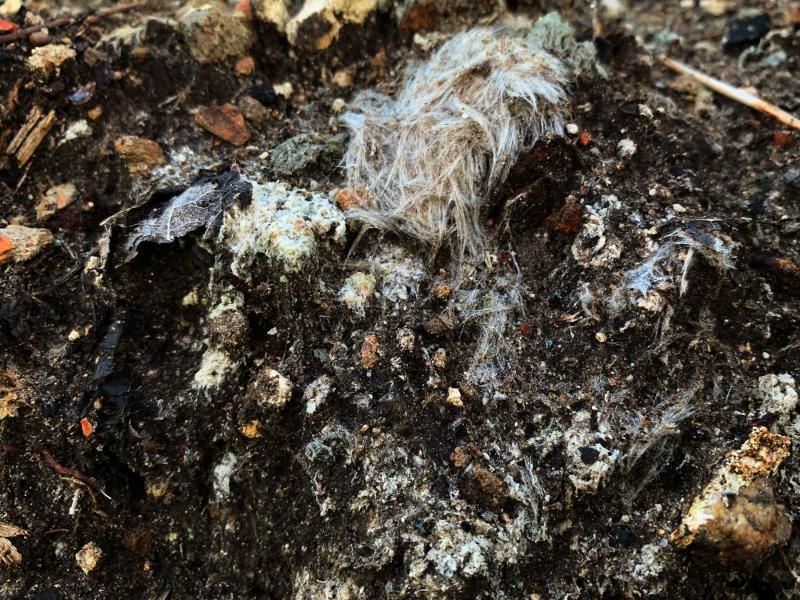
What is asbestos
Asbestos comprises silicate minerals with a fibrous structure.[4] When processed mechanically, the fibres split lengthwise into ever finer particles that the body finds hard to break down and remove.[1] Asbestos is not typically found as a natural mineral in Latvia, so all the asbestos found here was imported, mainly from Russia (the Urals) and Kazakhstan.[4][2]
Types of asbestos
Asbestos minerals are divided into two groups:[1]
| Group | Type | Fibres and notes |
|---|---|---|
| Serpentines | Chrysotile (“white asbestos”) | Long, curly, flexible fibres that can be spun. The most widely used type,[1] including in slate. Regarded as less dangerous than the amphiboles,[4] yet chrysotile too is a proven human carcinogen.[3][5] |
| Amphiboles | Crocidolite (“blue asbestos”) | Straight, needle-like fibres, far more brittle than chrysotile fibres.[1] |
| Amosite, or grunerite (“brown asbestos”) | ||
| Anthophyllite | ||
| Tremolite | ||
| Actinolite |
EU legislation defines asbestos as exactly these six fibrous silicates.[6] The International Agency for Research on Cancer (IARC) has concluded that all types of asbestos cause cancer in humans.[3]
Why the fibres are dangerous
Under the WHO definition, the fibres critical to health are those longer than 5 micrometres, with a diameter of less than 3 micrometres and a length-to-width ratio greater than 3:1.[1][6] Directive (EU) 2023/2668 requires fibres to be counted by electron microscopy, and from 21 December 2029 at the latest very thin fibres (under 0.2 µm) must also be taken into account.[6][7]
Where asbestos hides in a house
In Latvia, asbestos is most often found in roof coverings, insulation materials, floor and ceiling coverings, vehicle brake pads and even garden ornaments and equipment.[9] In houses built or renovated before 2000, it may also be present in the following places:[10]
- Slate roofs: on houses, sheds, saunas and garages.
- Asbestos-cement facade and wall panels, including under later cladding.
- Chimney flues and ventilation pipes made of asbestos cement.
- Rain gutters and downpipes.
- Thermal insulation on heating pipes in basements and heating substations.
- Asbestos-cement drinking water and sewer pipes.[2]
- Stoves and cookers: seals, asbestos rope for the doors, insulating boards.
- Electrical distribution boards: the insulating panel behind old meters.
- Old floor tiles and their adhesive.
- Partition, ceiling and fire-resistant boards, including around boilers and behind radiators.
In the garden, too: in Latvia asbestos is often found in garden ornaments and equipment,[9] for example flower boxes and bed edgings made from old slate or asbestos cement. They must not be sawn or broken, and they are disposed of in the same way as slate.
If you are planning to renovate an old building, first find out where the asbestos is. Under Directive (EU) 2023/2668, before demolition, maintenance or renovation of buildings constructed before the asbestos ban, the employer must establish where asbestos may be present, in particular by asking the building owner.[6][7]
How to recognise it
- Asbestos-containing materials are most often greyish, with a fibrous structure, and fairly friable when damaged.[9]
- It cannot be reliably identified by eye, so suspect material should be reported to a qualified specialist.[9]
- Samples for testing are taken from damaged material.[9] Afterwards the damaged spot is sealed with water, a special solution or adhesive so that fibres are not released.[11]
When was asbestos banned?
- 1973IARC experts conclude that there is sufficient evidence that asbestos is carcinogenic to humans.[1]
- 1988Hungary bans amphibole asbestos; it bans the use of chrysotile only in 2005, together with the other new EU Member States.[12]
- 2000In Latvia, Cabinet Regulation No. 158 of 25 April 2000 bans the sale and use of asbestos and asbestos-containing materials from 1 January 2001. Products already installed may stay in place but must be labelled. Even so, at least 1,380 tonnes of asbestos were still imported into Latvia in 2001.[4][12]
- 2005From 1 January, the placing on the market and use of chrysotile is also banned throughout the EU (Directive 1999/77/EC); amphibole asbestos had been banned earlier.[1][2]
- 2006The EU bans the extraction of asbestos and the manufacture of asbestos products (Directive 2003/18/EC).[1]
- 2023Directive (EU) 2023/2668 cuts the occupational exposure limit tenfold, from 0.1 to 0.01 fibres/cm³; Member States must apply it from 21 December 2025.[6][7]
- 2025Cabinet Regulation No. 731 of 9 December 2025 amends Cabinet Regulation No. 852, transposing Directive (EU) 2023/2668: a new exposure limit, a VDI permit for removal work, fibre counting by electron microscopy and identification of asbestos before work begins.[13][14]
The ban applies to new products. Asbestos already present in buildings does not have to be removed automatically,[12] but it must be handled responsibly, and safety requirements must be followed during demolition or renovation.
Asbestos in the world today
Although asbestos is banned in the EU, it is still mined elsewhere in the world. The US Geological Survey estimates that about 960,000 tonnes of asbestos were mined in 2025: about 310,000 t in Russia, about 250,000 t each in Kazakhstan and China, and about 150,000 t in Brazil.[15] 74 countries have banned asbestos completely (IBAS, June 2026).[16] British Geological Survey data show that in 2000–2010 several countries in the region, Latvia among them, were still importing asbestos.[1]
Asbestos can be replaced with synthetic and natural fibres such as polyvinyl alcohol, polypropylene and cellulose.[1]
Sources
- I. Banduch, L. Lißner (Kooperationsstelle Hamburg IFE). Azbesta izraisītās arodslimības Centrālās un Austrumeiropas valstīs: kopsavilkums [Asbestos-related occupational diseases in Central and Eastern European countries: summary]. EFBWW, 2013 (with the support of the European Commission)
- D. Sprūdža. Azbests darba vidē [Asbestos in the working environment]. RSU DDVVI, 2014 (seminar presentation)
- IARC (International Agency for Research on Cancer): About Asbestos
- Valsts darba inspekcija: Azbests [State Labour Inspectorate: Asbestos] (information material)
- WHO: Asbestos: elimination of asbestos-related diseases (fact sheet, 11 Aug 2026)
- Eiropas Parlamenta un Padomes Direktīva (ES) 2023/2668, ar ko groza Direktīvu 2009/148/EK [Directive (EU) 2023/2668 of the European Parliament and of the Council amending Directive 2009/148/EC] (Latvian-language version)
- EU-OSHA: Directive 2009/148/EC — exposure to asbestos at work (as amended by Directive 2023/2668)
- D. Sprūdža, Ž. Martinsone. Azbesta ietekme uz veselību [The health effects of asbestos]. RSU Institute of Occupational Safety and Environmental Health, Laboratory of Hygiene and Occupational Diseases, 2015 (seminar presentation)
- I. Mārtiņsone. Likumdošanas prasības (REACH, CLP, drošības datu lapas) [Legislative requirements (REACH, CLP, safety data sheets)]. RSU DDVVI seminar “Ķīmisko darba vides riska faktoru novērtēšana būvniecībā” [Assessment of chemical risk factors in the working environment in construction], Riga, 30 September 2020 (presentation)
- HSE: Diagrams showing where asbestos can occur in buildings
- A. Seile. Azbestu saturošu materiālu inventarizācija ēkās, atpazīšana un identifikācija [Inventory, recognition and identification of asbestos-containing materials in buildings]. RSU HASL, 2015 (presentation)
- International Ban Asbestos Secretariat: Chronology of Asbestos Bans and Restrictions (rev. 17 Feb 2026)
- MK 2004. gada 12. oktobra noteikumi Nr. 852 “Darba aizsardzības prasības darbā ar azbestu” [Cabinet Regulation No. 852 of 12 October 2004 “Labour Protection Requirements for Work with Asbestos”] (version as amended by Cabinet Regulation No. 731 of 9 December 2025)
- Cabinet Regulation No. 731 of 9 December 2025 “Grozījumi Ministru kabineta 2004. gada 12. oktobra noteikumos Nr. 852 …” [Amendments to Cabinet Regulation No. 852 “Labour Protection Requirements for Work with Asbestos”] (Latvijas Vēstnesis, 11 Dec 2025, No. 239) (in Latvian)
- U.S. Geological Survey: Mineral Commodity Summaries 2026 — Asbestos
- International Ban Asbestos Secretariat: Current Asbestos Bans (rev. 23 Jun 2026)
Content checked: 01.11.2026