
Slate roofs at home: are they dangerous and what should you do?
Grey corrugated asbestos-cement (“slate”) roofing sheets cover the roofs of many Latvian houses, sheds and saunas, and they almost certainly contain asbestos. As long as the sheets are intact and nobody disturbs them, they pose no significant risk to health. The risk arises when slate is broken, sawn, drilled or sanded, or when it starts to crumble of its own accord.[1]
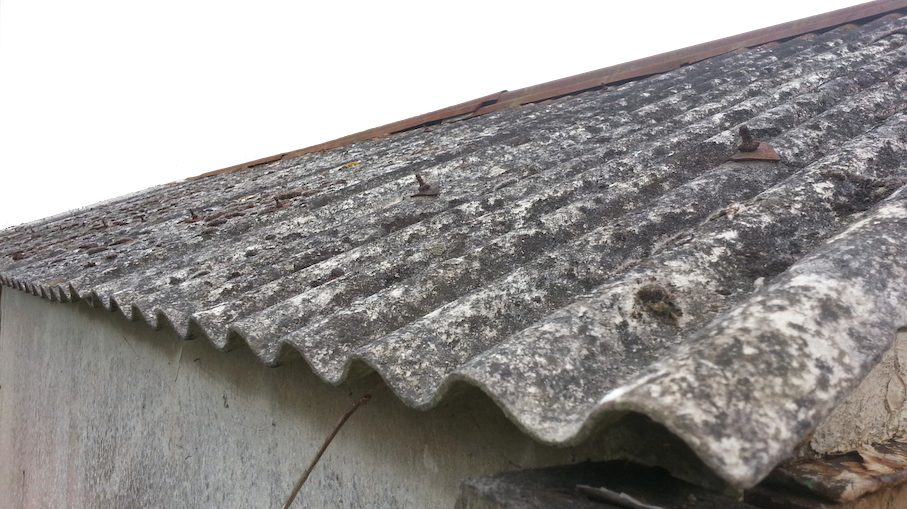
How to recognise asbestos slate
Slate is asbestos cement: a Portland cement mortar in which asbestos fibres act as reinforcement. In Latvia it was produced in Riga from 1935 and in Brocēni from 1938, and every 1,000 sheets used around 1,250 kg of cement and 124 kg of asbestos.[3]
- Appearance: grey corrugated or flat sheets. Asbestos-containing materials are most often greyish with a fibrous structure, and become friable when damaged.[5]
- Age: if the roof was laid before 2002, assume it contains asbestos. In Latvia, Cabinet Regulation No. 158 of 25 April 2000 banned the use and sale of asbestos and asbestos-containing materials from 1 January 2001; even so, at least 1,380 t of asbestos was still imported in 2001.[6] The use of asbestos has been banned throughout the EU since 2005.[4]
- At a break, fine fibres are often visible. Do not tear or break sheets to check this!
- If in doubt: a sample can be sent to an accredited laboratory. Take the sample from material that is already damaged, then seal the damaged spot with water, a sealing solution or adhesive.[7][5]
Slate is not the only place in a house where asbestos may be found. See “Where asbestos hides in a house”.
Is my roof dangerous?
Asbestos is dangerous when its fibres are inhaled.[4] Intact slate that nobody disturbs releases no significant amount of fibres.[1] Over time, however, weathering wears the material down and it crumbles, gradually releasing harmful substances.[8]
Can be left in place, with regular checks
- the sheets are intact, with no cracks;
- the surface is hard and does not crumble;
- the roof does not leak and needs no repairs.
Time to plan a replacement
- the sheets are cracking, breaking or have holes;
- the surface crumbles and the edges are fraying;
- grey debris builds up in the gutters or under the roof.
If you are replacing your roof
The safest option is to entrust the work to a company. Since December 2025, a company needs a permit from the State Labour Inspectorate (VDI) to remove asbestos-containing materials, and the VDI publishes a list of permit holders on its website.[10] Before signing a contract, check that the firm is on this list (vdi.gov.lv).
If you do remove the roof yourself, follow these steps:
- Protection. Disposable overalls, gloves, a P3 respirator and footwear that can be washed.[11] An ordinary dust mask or medical mask does not protect you.
- Prepare the site. Close windows and doors, keep children and pets well away from the work area, and spread plastic sheeting on the ground. Work on a windless day.
- Wet it down. Spray the sheets with water (using a garden sprayer, not a pressure jet) so that fibres do not rise into the air. Asbestos fibres can remain in the air of a work area for as long as 70–80 hours after the work.[12]
- Do not break or saw. Slate must not be broken, as this produces dust that is dangerous to health and the environment.[11] Unscrew or carefully pull out the fixings, lift the sheets off whole and do not throw them to the ground. Do not use an angle grinder, saw or drill.
- Take care on the roof. Old slate is brittle and must not be walked on, as you may fall through. Use boards or a ladder.
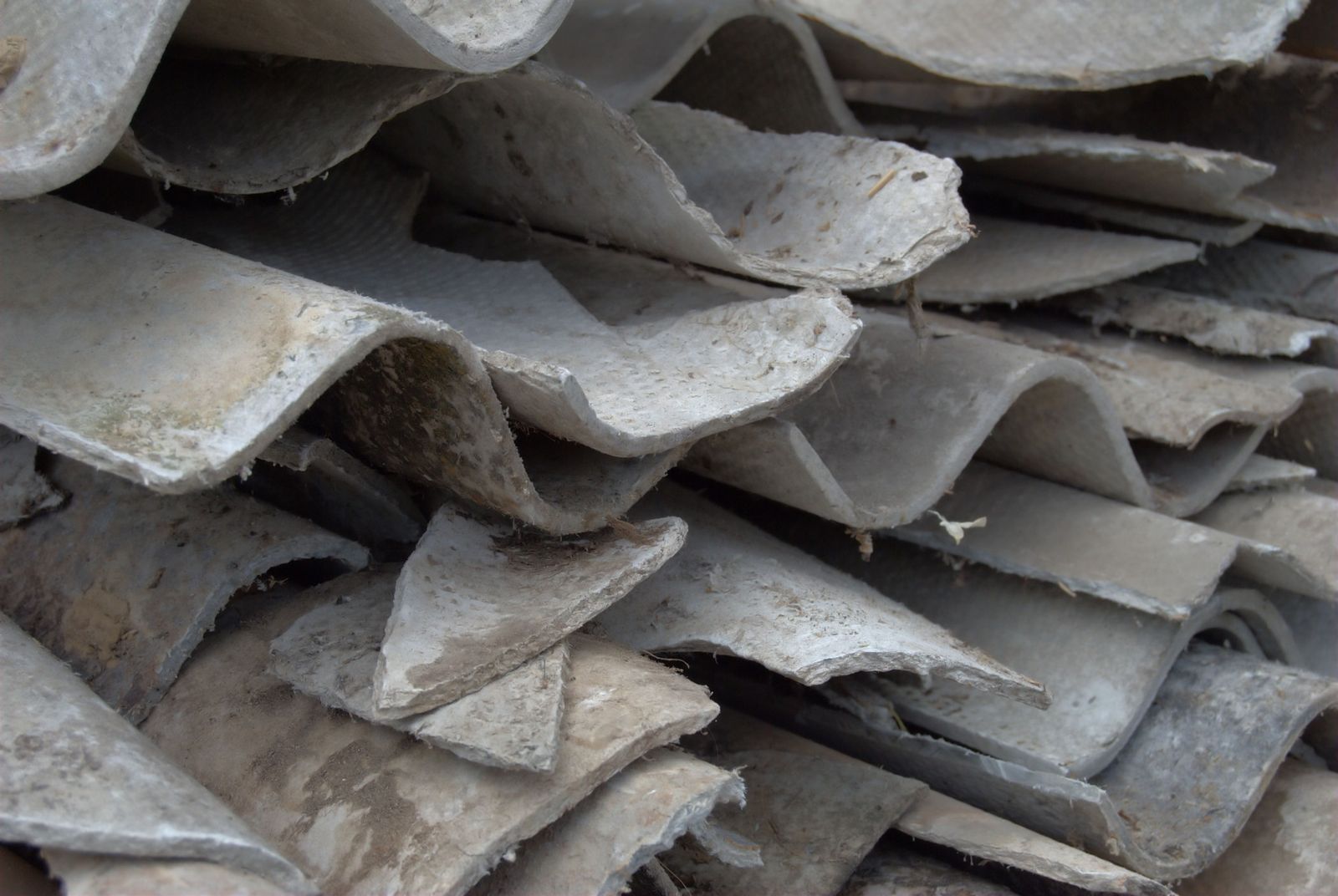
- Pack it. Stack whole sheets on a pallet and wrap them in plastic film; put broken pieces into large bulk bags (“Big Bags”; about €7–8 per bag, 2023 figures).[13] Store them separately from other building materials.
- After the work. Put the overalls, gloves and filter into a bag together with the waste. Wash thoroughly. Do not take work clothes home, as fibres on clothing can endanger your family.[14]
Where to dispose of it and what it costs
Slate is hazardous waste.[15] It may only be delivered to landfills that hold a permit from the State Environmental Service (VVD).[2] There it is disposed of in a separate cell.[9]
- In 2024 the skiroviegli.lv website listed 18 acceptance points for asbestos-containing waste.[8] An up-to-date map is available at skiroviegli.lv.
- Riga’s “Getliņi” landfill (2023 data) is not permitted to accept asbestos, so slate from the Riga region has to be taken to another region.[13]
- In 2025 the hazardous waste operator “BAO” quoted a price of €550 per tonne excluding VAT, covering transport, temporary storage, repacking and disposal at a landfill.[1] Prices vary, so compare several offers. 10 sheets weigh roughly 0.2 t.[11]
- Before you set off, call the landfill to check whether it is currently accepting slate and how it must be packed.
State support for disposing of slate
The Asbestos Support Programme (Ministry of Climate and Energy, funded by the Latvian Environmental Protection Fund) covers all costs: packaging, packing, transport and delivery to a landfill.[11]
- Each household can hand over between 0.2 t (~10 sheets) and 3 t (~150 sheets).[11]
- The property must be owned or co-owned by the applicant, and no business activity may be registered there.[11]
- The 2026 round was intended for holders of the “Latvian Honorary Family” (Goda ģimene) card (budget €300,000). Applications closed on 17 July 2026; approved applicants can receive the service until 30 November 2026.[11] Only one applicant per household may apply.[11]
- In 2024 needy and low-income households could apply, and from June also Latvian Honorary Families.[16][17] The 2025 round was for Honorary Families;[18] 260 households handed in about 685 tonnes of slate.[2]
For 2027 the ministry plans the same level of funding (€300,000).[2] New rounds are announced by the ministry, so keep an eye on kem.gov.lv and ask your local authority.
What you must not do
- Bury slate in the ground or use it to fill in roads.[2]
- Crush it and use it for a road surface or base, or for the paths between allotment beds.[1][16]
- Throw it out with household waste or ordinary construction debris.[1]
- Break or crush it: this creates hazardous dust.[11]
Illegal handling of slate (for example, burying it or using it for road surfacing) can lead to a fine: €70–700 for individuals and €280–1,400 for legal entities (2025 figures), plus the cost of clearing it up.[1] Buried slate wears down and crumbles over time, and asbestos can get into the soil, water and air.[8]
Frequently asked questions
Is it safe to live in a house with a slate roof?
Yes. Slate lying undisturbed on a roof does no harm. Dust is released when it is disturbed, moved or crushed.[1]
Can I use rainwater from a slate roof?
For watering the garden, generally yes. We do not recommend drinking rainwater from any roof, whatever it is made of. Asbestos can also enter the body through water,[12] but there is no convincing evidence that ingested asbestos is harmful to health; disease is caused mainly by inhaled fibres.[19]
Is an ordinary dust mask enough?
No. You need a respirator with a P3 filter[11] that fits tightly to your face. A respirator does not seal well over a beard.
My neighbour is breaking up slate and spreading it on the road. What should I do?
Report it to the State Environmental Service (VVD) in the “Vides SOS” app or by phone on +371 26338800.[20] More on the Pollution and reporting page.
I have already broken slate without protection. Am I at risk of disease?
The risk increases with the duration and intensity of exposure,[4] but there is no safe dose of asbestos.[14] Do not panic, but tell your GP about it and protect yourself from now on. If you smoke, stop: in people exposed to asbestos, smoking increases the risk of lung cancer 9–10 times.[12][21]
May I store slate in my yard until I have saved up enough to dispose of it?
Keep whole sheets stacked and covered with plastic sheeting so that they do not crumble and children cannot get at them. Slate stored for a long time wears down and crumbles.[8] If you meet the conditions of a state support round, apply as soon as it is announced.
Sources
- LSM: Kur likt veco šīferi? Saimnieki cer uz valsts atbalstu [Where to put old slate? Homeowners hope for state support] (2025)
- KEM / LV portāls: Azbesta atbalsta programmā savākta 685 t šīfera [685 t of slate collected under the Asbestos Support Programme] (2025)
- I. Grosvalds, R. Grāvelsiņš (Rīgas Cementa un šīfera rūpnīca [Riga Cement and Slate Factory]). Par tehnikas vēsturi Latvijas PSR, VI [On the history of technology in the Latvian SSR, vol. VI]. Riga, 1964
- I. Banduch, L. Lißner (Kooperationsstelle Hamburg IFE). Azbesta izraisītās arodslimības Centrālās un Austrumeiropas valstīs: kopsavilkums [Asbestos-related occupational diseases in Central and Eastern European countries: summary]. EFBWW, 2013 (with the support of the European Commission)
- I. Mārtiņsone. Likumdošanas prasības (REACH, CLP, drošības datu lapas) [Legislative requirements (REACH, CLP, safety data sheets)]. RSU DDVVI seminar “Ķīmisko darba vides riska faktoru novērtēšana būvniecībā” [Assessment of chemical risk factors in the working environment in construction], Riga, 30 September 2020 (presentation)
- Valsts darba inspekcija: Azbests [State Labour Inspectorate: Asbestos] (information material)
- A. Seile. Azbestu saturošu materiālu inventarizācija ēkās, atpazīšana un identifikācija [Inventory, recognition and identification of asbestos-containing materials in buildings]. RSU HASL, 2015 (presentation)
- LV portāls: Nepieciešama sabiedrības izpratne par azbestu saturošo atkritumu bīstamību [Public awareness of the hazards of asbestos-containing waste is needed] (2024)
- MK 2011. gada 19. aprīļa noteikumi Nr. 301 [Cabinet Regulation No. 301 of 19 April 2011] on environmental pollution caused by asbestos and the management of asbestos waste
- MK 2004. gada 12. oktobra noteikumi Nr. 852 “Darba aizsardzības prasības darbā ar azbestu” [Cabinet Regulation No. 852 of 12 October 2004 “Labour Protection Requirements for Work with Asbestos”] (version as amended by Cabinet Regulation No. 731 of 9 December 2025)
- KEM / LV portāls: Latvijas Goda ģimenēm pieejams atbalsts azbestu saturošā šīfera nodošanai [Support available to Latvian Honorary Families for disposing of asbestos-containing slate] (2026)
- D. Sprūdža, Ž. Martinsone. Azbesta ietekme uz veselību [The health effects of asbestos]. RSU Institute of Occupational Safety and Environmental Health, Laboratory of Hygiene and Occupational Diseases, 2015 (seminar presentation)
- VARAM: Izvērtējums par azbestu saturošo atkritumu apjomiem Latvijas pašvaldībās [Assessment of the volumes of asbestos-containing waste in Latvian municipalities] (2023)
- Eiropas Parlamenta un Padomes Direktīva (ES) 2023/2668, ar ko groza Direktīvu 2009/148/EK [Directive (EU) 2023/2668 of the European Parliament and of the Council amending Directive 2009/148/EC] (Latvian-language version)
- MK 2011. gada 19. aprīļa noteikumi Nr. 302 “Noteikumi par atkritumu klasifikatoru un īpašībām, kuras padara atkritumus bīstamus” [Cabinet Regulation No. 302 of 19 April 2011 “Regulations on the Waste Classification and the Properties that Render Waste Hazardous”]
- VARAM / LV portāls: Atbalsta programma trūcīgajiem šīfera nodošanai [Support programme for needy households to dispose of slate] (2024)
- VARAM / LV portāls: Azbestu saturošā šīfera nodošanai var pieteikties arī Latvijas Goda ģimenes apliecības turētāji [Holders of the Latvian Honorary Family card may also apply to hand in asbestos-containing slate] (2024) (in Latvian)
- KEM / LV portāls: Latvijas Goda ģimenes aicinātas pieteikties azbestu saturošā šīfera bezmaksas nodošanai [Latvian Honorary Families invited to apply for free disposal of asbestos-containing slate] (2025) (in Latvian)
- WHO: Guidelines for Drinking-water Quality, chemical fact sheet: Asbestos (2022)
- VVD / LV portāls: Gandrīz 8000 ziņojumu gadā [Nearly 8,000 reports a year] (2026)
- WHO: Asbestos: elimination of asbestos-related diseases (fact sheet, 11 Aug 2026)
Content checked: 01.11.2026